KYC Onboarding UX: Benchmarks From 50 Fintech Products
Written by Mara Bureau · Published [date] · Last updated [date]
KYC onboarding loses most users through design, not regulation. Regulators decide what you must collect; your product decides when, how and in what order. In our review of 50 fintech products, the biggest leaks were document upload, unexplained verification waits, and asking for personal data too early: 34 of the 50 asked for details like date of birth or address before showing the product at all.
What does the law actually require at sign-up?
Less than most onboarding flows ask for. Under the US Customer Identification Program rule for banks, 31 CFR 1020.220, a bank must collect at minimum a name, a date of birth for individuals, an address and an identification number before opening an account. The rule says nothing about the order of screens, the copy, or what users see while they wait.
In the EU, the EBA Guidelines on remote customer onboarding (EBA/GL/2022/15), applied since October 2, 2023, add requirements on how evidence is captured: images clear enough to verify, a secure channel, and timestamped records kept for audit. Good document-capture design is part of meeting those rules, not a trade-off against them.
What the table shows: the legal minimum is short. Everything else is a product decision, and each extra field at sign-up is a reason to leave.
Limit: lending, brokerage and crypto products often have extra obligations, such as affordability or suitability checks. Collect that data at the step that needs it, and say why on the screen. Confirm the exact list with your compliance team for each market.
Where do users drop out of KYC onboarding?
In our review, three steps caused most of the visible friction across neobanks, lending, payments and crypto products.
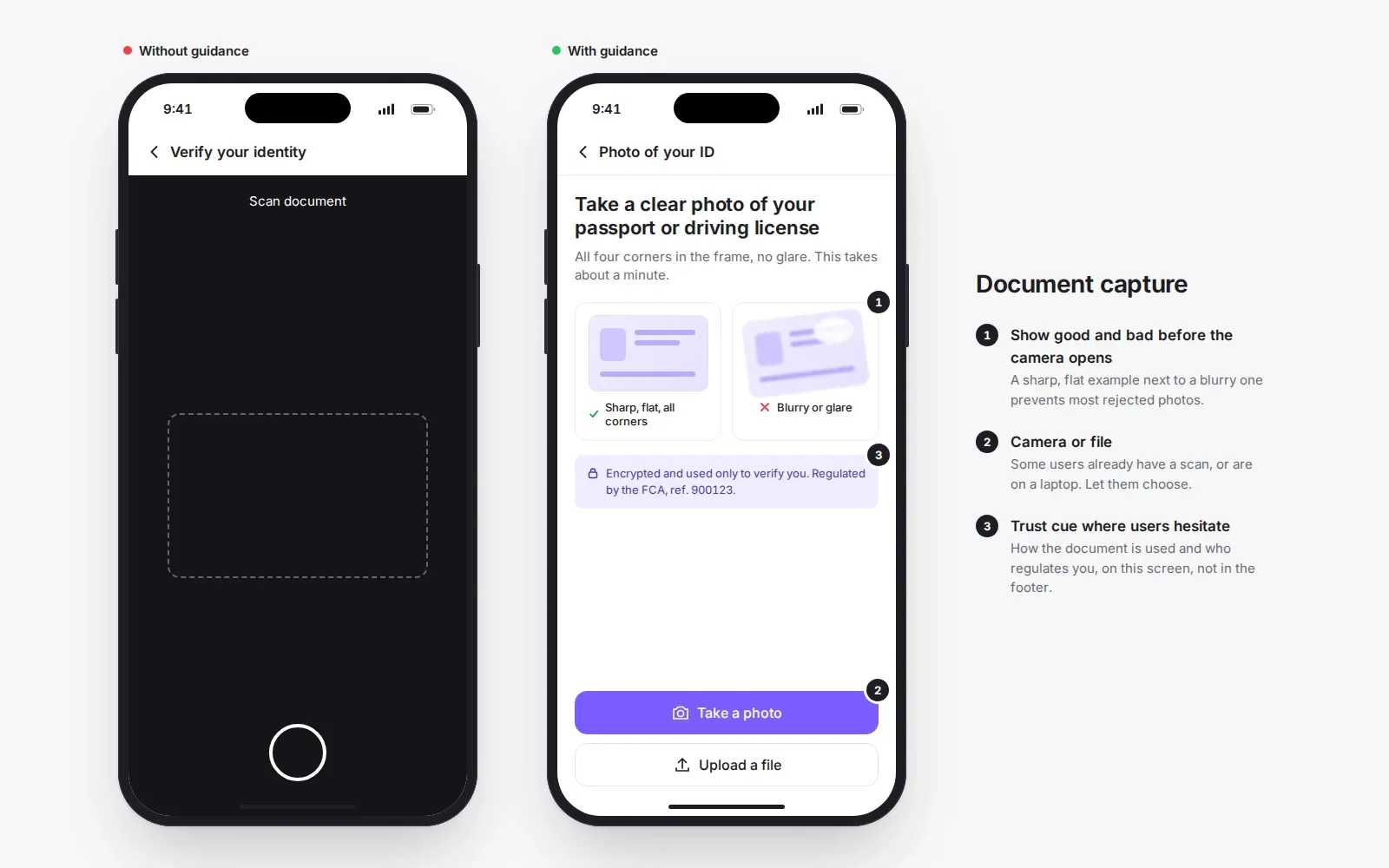
1. Document upload. Among products that required a photo of an ID, this was the most common friction point. The best ones gave format guidance before the camera opened, offered both camera capture and file upload, and checked the photo immediately instead of rejecting it after the user submitted the whole form.
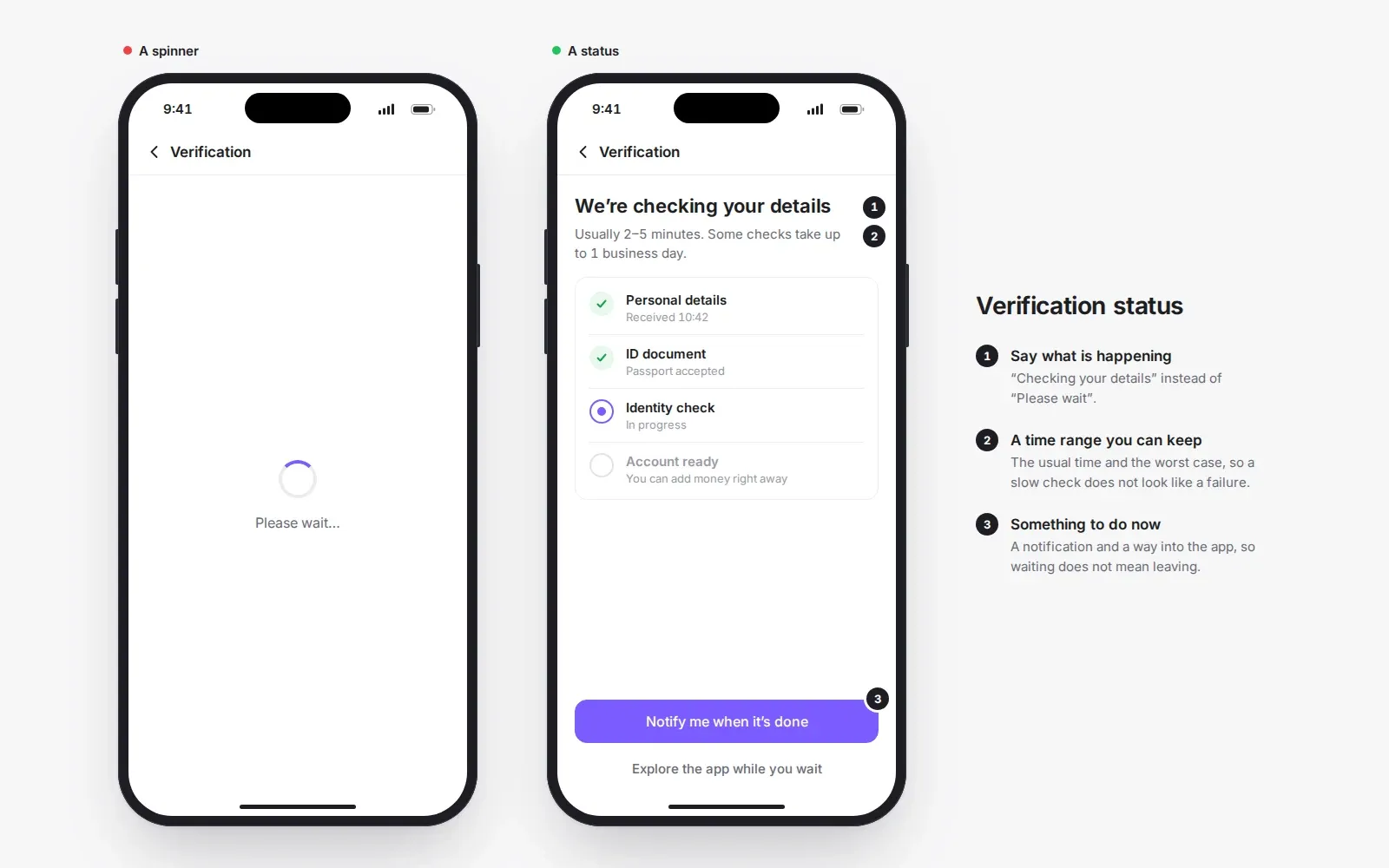
2. Unexplained verification waits. Automated checks sometimes take longer than expected. More than half of the products showed nothing between “uploading” and “verified” except a spinner. Users read silence as failure, close the app and contact support.
3. Premature data collection. 34 of 50 products asked for date of birth, address, employment or a tax ID before the user had any sense of the product. The best flows collected the minimum to show the product, then asked for the rest when a specific action needed it.
What are good KYC onboarding benchmarks?
These are working benchmarks from our review of 50 products and our own project work, not an industry census. Use them to spot where your flow is far off, not as targets to report.
What the table shows: if completion is below 55%, look at document upload and the verification wait first. Both are fixable in weeks.
Limit: completion depends on your audience and market. A regulated lending product will complete lower than a prepaid card. Compare your numbers over time and by step, not only against this table.
How should you design each step of KYC onboarding?
Design KYC as seven steps, each with one job. The regulatory checks stay the same; what changes is what the user knows at each moment.
- Set expectations first. Before the first field, show what the user will need and how long it takes: “Have your passport or driving license ready. This takes about 3 minutes.” Limit: keep it to one screen; a long explainer becomes another step to skip.
- Collect the minimum to show value. Email or phone and a password, then let the user see the product. Ask for the legal minimum when they want to use money features. Limit: some products cannot show anything before verification, such as regulated investment accounts; then show a preview with sample data.
- Guide document capture. Show a good and a bad example, offer camera and file upload, and check focus, glare and crop in real time. Limit: real-time checks depend on your verification vendor; if it cannot do them, at least validate size and format before upload.
- Explain the selfie. Say why you need it, in one line, and give lighting tips before the camera opens. Limit: some users cannot complete a liveness check, so offer a fallback path such as manual review.
- Show verification status. Replace the spinner with a status screen: what is being checked, the usual time, and what happens next. Send a notification when it finishes. Limit: do not promise a time you cannot meet; show a range.
- Make failure specific. “Your photo is blurry” beats “Verification failed.” Give the exact fix, a retry button and a way to reach a person. Limit: some rejection reasons, such as sanctions hits, cannot be explained to the user; then say a person is reviewing it and when they will reply.
- Get to the first meaningful action fast. After approval, take the user straight to adding money or making a first payment, not to a feature tour.
Where should trust signals go in KYC onboarding?
On the screens where users hand over sensitive data. In 41 of the 50 products we reviewed, encryption notices, regulatory registrations and partner bank logos appeared in the footer or on a separate security page.
Place one short, specific cue at each of those moments: the regulator and licence on the ID screen, the partner bank on the linking screen, and a line on how documents are stored. Limit: more badges do not mean more trust. One relevant line at the right moment does more than a row of logos.
What breaks KYC onboarding on mobile?
Most KYC happens on a phone, and many flows are designed for desktop first. Of the 31 products in our review with both web and mobile versions, 24 shipped mobile as a compressed version of the web layout, and 18 had buttons with touch targets under 44 px.
The fixes are basic and often skipped: fields that move to the next input automatically, the right keyboard for each field (numbers for dates and codes), camera capture as the default for documents, and buttons large enough to hit on the first try. Limit: some desktop users onboard for business accounts; for B2B products, test both.
What do we see in KYC projects?
Three patterns come up in almost every KYC flow we work on.
- Teams blame the vendor, but the fixes are around it. The verification SDK is rarely the main problem. The screens before and after it, guidance, waiting and errors, decide most of the drop-off.
- Compliance and design work better in one room. When compliance reviews copy at the end, every screen gets longer. When they help write it at the start, the same requirement fits in one plain sentence.
- Most teams do not measure by step. They know overall completion, not which screen loses people. A step-level funnel is usually the first thing we set up, because it decides what to fix first.
KYC onboarding UX checklist
- We ask only for the legal minimum before the user sees the product.
- The first screen says what documents are needed and how long it takes.
- Document capture shows examples and checks the photo before submission.
- Users can choose camera capture or file upload.
- The selfie step explains why and gives lighting tips.
- A status screen with a time range replaces the spinner.
- Every failure message names the cause and the fix.
- There is a path to a person for failed or stuck verifications.
- Security and regulatory cues appear on the document and bank-linking screens.
- We track completion for every step, on mobile and web separately.

 Latest articleHow to Choose a Design Agency in 2027: A Practical Checklist
 Case studyiGaming Branding & Web Design: Crypto Casino